The May frenzy has passed, so there is a chance and space for another installment of the story of Dill and his Fino. Below is an excerpt from an interview with me that appeared in Chef magazine
Enjoy your reading!
J.K..
The May frenzy has passed, so there is a chance and space for another installment of the story of Dill and his Fino. Below is an excerpt from an interview with me that appeared in Chef magazine
Enjoy your reading!
J.K..
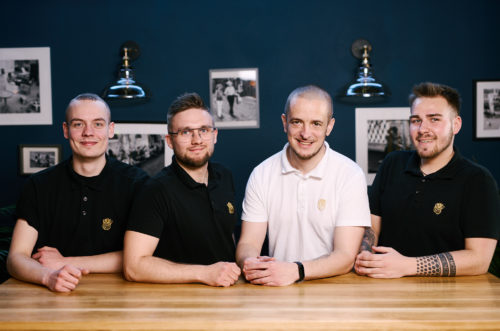
I’m from a sports school, I didn’t have any major kitchen experience before. My dad wanted me to go to a vocational school and get a profession, I didn’t feel it, so I went to a high school with a sports profile, because the field was my second home. I thought I would become a basketball player, but I’m too short and I don’t think I have any talent in this field. I went to several post-secondary schools, including one related to hospitality and services. It turned out that I had to do internships in the kitchen and in the hall. I knew I wasn’t suited for the hall, I didn’t like being among people, while I could sit in the kitchen for a whole month, even though I had nothing to do with it before.
Thanks to my mother’s connections, I ended up at the Haffner Hotel in Sopot. At that time I had already dropped out of that post-secondary school, so I didn’t have to participate in the internship. I did it only so as not to make my mother uncomfortable. There I saw a totally different world, I found that this was the place for me. In addition to the fact that there is hard work, there is time for jokes. There is a climate.
I didn’t have the impression that I ended up in the army, as some people perceive the kitchen. When one of the cooks salted my coffee, I did the same to him. I didn’t feel inferior in rank. It was also a bit of a problem for me, because I was sometimes wayward and the guys would chase me. But I found that once I was here, I didn’t want to come at eight o’clock to peel potatoes, but to actually learn something.
So I started coming later, for the service time, I helped and caught the bug. After a month of being there I found that this is the place for me, that I can do something, and people don’t see me, I’m part of the team. Only if I prove that I can work hard, I will receive praise for it, it will affect motivation.
Then I sent out fifteen resumes – one to Gdynia and the rest in Sopot. I only had those one-month internships listed there, so practically nothing. I don’t know why I hoped that someone would take me on somewhere. But I was contacted by the owner of the “La Vita” restaurant in Gdynia and he said that if I showed him that I could work hard, he would hire me, and since I was also working in a supermarket at the time, I was willing to do anything to stay in that restaurant.
I started with $4/hour and peeling potatoes.
One of the cooks from Haffner also came in at the time and was surprised to see me. It turned out that those from Haffner helped run that kitchen. He told my superiors that I was hard-working, but also needed to be watched out for. That’s where it all started. The second breakthrough moment was when I did the dry storage order. Since I had supermarket experience, I arranged all the products just like in the store. It was said at the time that there had never been such order that you could take a cart and shop.
Step by step I developed in the kitchen. My assumption was always to work in the best place in the area. Then this Italian restaurant
It was only after reading the book “Kill Grill Anthony” by Bourdain that I understood what it was all about. Then I appreciated it. Over time I developed in more very good restaurants, mostly Italian – “La Fortuna”, “Tutta Mia”.
I was greatly influenced by working at the Sheraton in Sopot. Five-star cuisine – I was terrified when I entered there. But it turned out that hard work is always appreciated, so I did my job, and Krystian Szidel showed me a good school.
The turning point was “Trick”. Rafal Walesa, a brilliant chef, an artist through and through, opened my mind. He showed me what I could do with all the knowledge I had gathered. And even then I thought I knew something there.
Working with books or some self-development didn’t give me as much as that one shot, that kind of spark ignited, that I’m the one creating all this, I’m the one putting the ingredients together and defining the plate. I was there for four years, three of which I was head chef. It was very high pressure, but also a brilliant experience.
There came a point where I already knew I couldn’t go anywhere else, because there was nothing better for that time. It got to the point where I was approached by my former boss, the owner of “La Fortuna,” and asked if I was interested in opening something together.
We opened “Fino” in Gdansk and “Osteria Fino” in Gdynia.
I wanted to create something from scratch. The nickname “fennel” had always followed me and the idea was to make it into some cool short name. In Italian it was finocchio and I was already very close to giving it that name, but it turned out that’s how Italians speak contemptuously to homosexuals. So I decided that “Fino” was a hit, plus a solid base of fennel in the signboard and everywhere, and in other languages it means nice, good, quality. It suited me a lot, hence fennel is the theme :)
To be continued…